Qualified doctors
A good centre has highly qualified doctors. Surgeons certified by the American Board of Hair Restoration Surgery (ABHRS) are preferred; you can check a surgeon on the ABHRS website. Read why ABHRS and ISHRS matter.
Patient guide · Hyderabad
Experienced. Expert. Ethical.
A 12-point checklist, 10 questions to avoid scams, and the biggest red flag
When choosing a hair transplant centre, the surgeon's qualifications and the team's methods matter most. The points below are what to look for and ask about, whether you choose FUE, FUT or combination.
What to look for
A good centre has highly qualified doctors. Surgeons certified by the American Board of Hair Restoration Surgery (ABHRS) are preferred; you can check a surgeon on the ABHRS website. Read why ABHRS and ISHRS matter.
Membership of the International Society of Hair Restoration Surgery (ISHRS) shows that a doctor keeps up with developments in hair restoration. You can search the ISHRS website.
Doctors trained in ACLS and BLS (life-support courses recommended by the American Heart Association) are better prepared to handle any emergency.
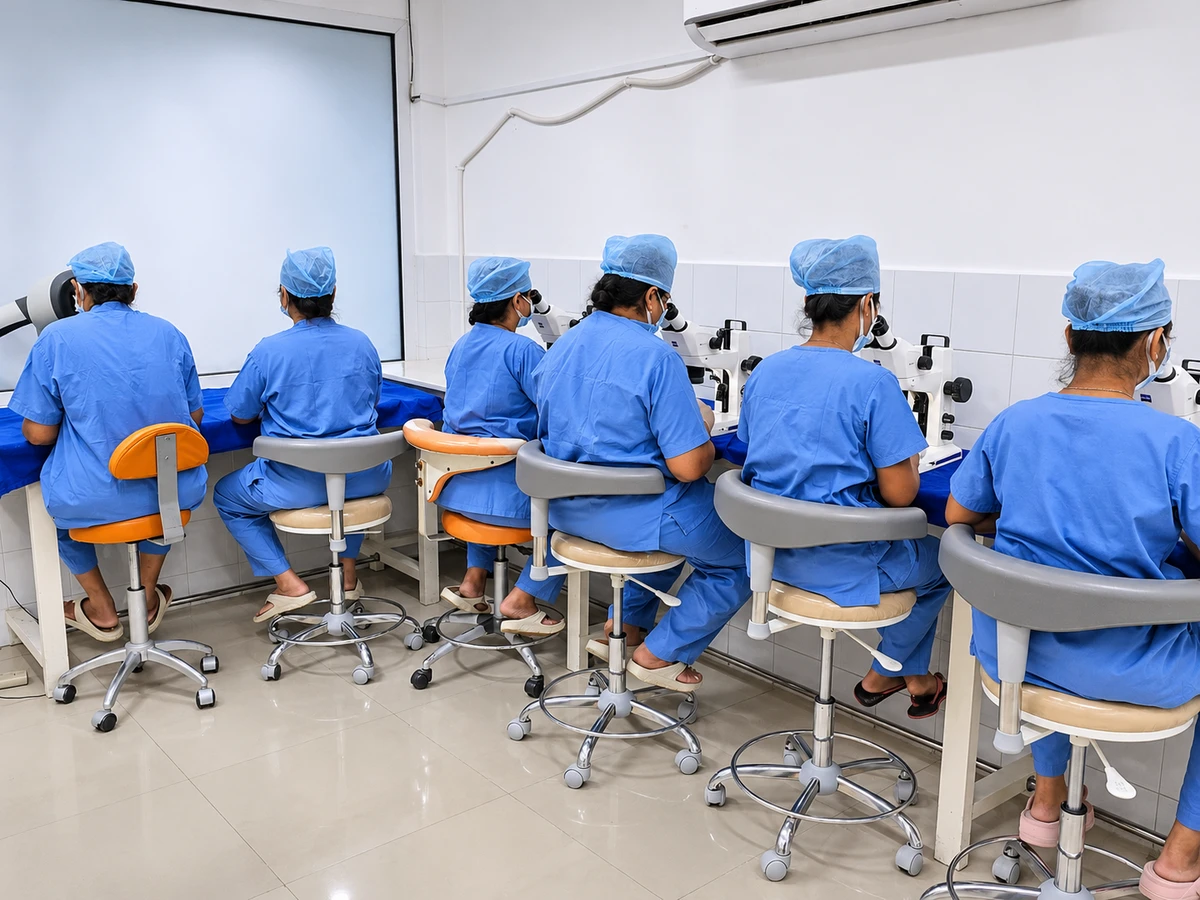
A hair transplant is not a one-person job. It needs a team of surgical assistants who are skilled at dissecting and implanting grafts.
The centre should have the latest microscopes: stereo microscopes (Zeiss), Mantis microscopes and surgical loupes (Zeiss), to produce the ultra-refined follicular units needed for dense packing near the hairline, and highly natural moustache, beard and eyebrow transplants. Not only the equipment but also well-trained doctors and technicians are essential.
The number of grafts transplanted in one session plays a major role in the outcome. The open method of dissection reduces damage to the follicles (transection). The team should be able to handle a case of 8,000 grafts in 8 hours, to deliver mega, super mega and giga sessions according to the needs of the patient.
Check whether the surgeon makes small incisions with micro-blades of 0.7 to 0.9 mm. They affect how natural the result looks by making dense packing possible. There are several kinds: custom-made, sapphire and diamond micro-blades, and the centre should be able to use all of them, depending on the need and choice of the patient. Custom blades can be made to the size and length of the follicular unit, and are disposable.
The doctors should be able to perform trichophytic closure, an advanced suturing method that minimises the scar in the donor area after FUT.
The centre should be able to carry out the procedure with minimal pain, and should follow strict sterilisation to minimise the chances of problems such as facial swelling, pain or infection.
The centre should be able to offer all types of hair transplant surgery: FUT, FUE, combination, body hair transplantation, eyebrow restoration, and beard and moustache reconstruction.
Centres devoted only to hair transplant surgery are a good option, as the centre should have highly qualified doctors and highly skilled technicians with a lot of experience, to deliver the best results with proper safety precautions.
The centre should have long experience of producing consistently good results with natural and undetectable hairlines. Ask to see before and after results.
Before you pay
Use this checklist when consulting any clinic, to protect your health, safety and investment.
Meet the doctor and ask about qualifications. Meet a dermatologist or plastic surgeon. Trichologists, cosmetic physicians, “hair specialists” and “hair experts” are not dermatologists or plastic surgeons. Ask who handles extraction, incisions, hairline design and implantation.
Ask whether your hair loss is stable and whether medication should come first. See am I a good candidate?
Get a medically justified estimate, not a sales package.
Ask how you will avoid overharvesting and visible thinning. See the donor area.
Ask for unedited before-and-after photos at 9 to 12 months.
Ask who treats you if something goes wrong after surgery.
Get a written breakdown of all costs and extra charges. See our per-graft prices.
Ask about revision policies and additional costs.
Ask for a personalised explanation, not a sales pitch.
Never let limited-time discounts or pressure rush your decision.
Biggest red flag: a clinic that guarantees results, promises unlimited grafts, or refuses to tell you exactly who performs the surgery.
Our centre
Dr. Madhu's Advanced Hair Transplant Centre, Road No. 36, Jubilee Hills, Hyderabad.
Questions
The surgery should be done by a dermatologist or plastic surgeon. Certification by the American Board of Hair Restoration Surgery (ABHRS) is preferred, and membership of the ISHRS shows that the doctor keeps up with developments in hair restoration.
You can check a surgeon on the ABHRS website (abhrs.org). Both doctors at Dr. Madhu's, Dr. Pathuri Madhu and Dr. P. Ram Sushruth, are ABHRS Diplomates.
A clinic that guarantees results, promises unlimited grafts, or refuses to tell you exactly who performs the surgery.
Ask who will perform the surgery, whether you are a good candidate, how many grafts you need, how much donor hair can be safely taken, what complications can occur, what the price includes, and why FUE, FUT or combination is recommended for you. Ask to see unedited results at 9 to 12 months.
Next step
Ask us every question on this page. In-person consultations in Jubilee Hills, Hyderabad, or an online consultation if you live outside Hyderabad.
Information on this website is general and does not replace a consultation with a doctor.
Send your hair loss details and scalp photos for an online evaluation, or speak directly with our doctors on WhatsApp or in-person in Jubilee Hills, Hyderabad.