Surgical Hair Restoration · Hyderabad
Body Hair Transplant in Hyderabad
Experienced. Exceptional. Ethical.
Body hair has a different texture and a shorter growth cycle than scalp hair, and it grows mostly as single-hair follicular units rather than the 2- to 4-hair clusters found on the scalp.
That is why the success of a body hair transplant relies heavily on where the grafts are sourced from, and on strict patient selection.
Medically reviewed by Dr. Pathuri Madhu, MBBS, MD · Dr. P. Ram Sushruth, MBBS, MD, ABHRS Diplomates
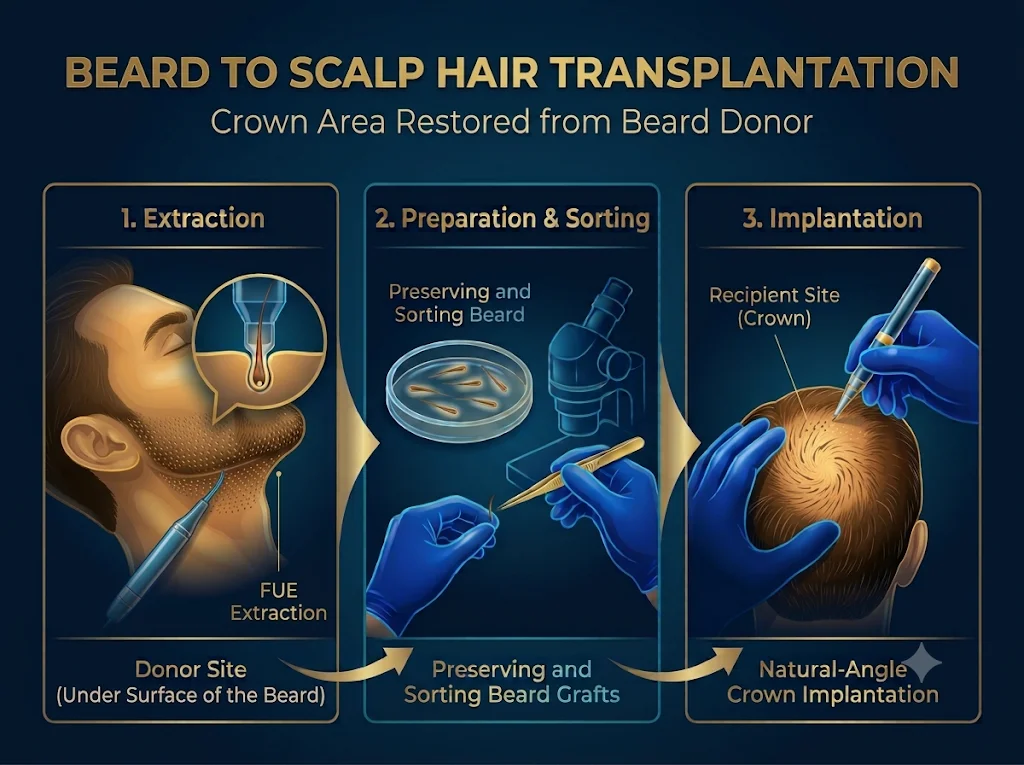
Crown Restoration via Beard & Body Hair
When the scalp donor area is depleted, FUE harvesting from the chin and torso provides viable follicles for crown fullness and scar camouflage.
Two Techniques
Beard to Scalp and Body to Scalp
When the back of the scalp has no more hair to give, there are two other places we can borrow from: your beard and your body.
Beard to Scalp Transplant
Your beard: the hidden donor area
If your beard hair is thick and strong, every graft adds real coverage to a thinning crown or mid-scalp. That makes it the best body donor source we have.
We take grafts only from the undersurface of the chin. This hidden area is the best place and our first choice in the beard, so your visible beard stays full and your face looks the same.
- 75% to 95% of grafts survive: The highest survival rate of any non-scalp donor hair.
- 500 to 2,000 grafts: Harvested safely depending on your individual beard density.
- Best for volume: Coarse caliber builds excellent visual density in the crown and mid-scalp.
- Not used for hairline: Kept away from the front hairline, which requires finer scalp hair.
Body to Scalp Transplant
Chest and torso hair to top up the supply
If your body hair is thick and sufficiently dense, hair from the chest and torso can add to what the scalp and beard provide when more grafts are needed.
Chest hair is finer, so it is usually placed alongside scalp or beard grafts to soften the result and fill smaller bald patches. Arm and leg hair is used only as a last resort.
- 50% to 75% chest graft survival: Reliable supplementary donor for extended coverage.
- Blends well: Softens harsh contrast when strategically mixed with scalp grafts.
- Conceals donor scars: Excellent for filling in earlier linear strip (FUT) surgical scars.
- Micropunch FUE: Individual follicle harvesting leaves no linear scarring on the body.
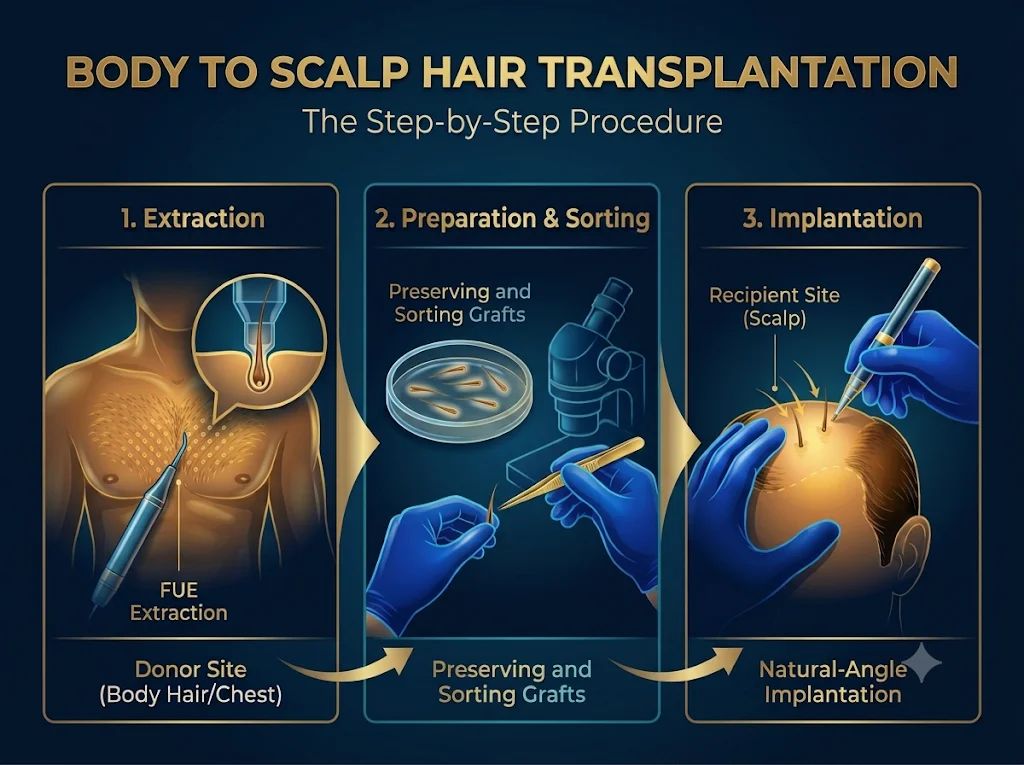
Sourcing & Survival
The Donor Source Hierarchy
Different areas of the body yield highly variable survival rates, hair caliber, and textures.
Beard Hair
If thick and strong, beard hair builds dense volume in the mid-scalp and crown. Its thick shaft and gentle natural wave offer superior visual coverage.
Chest & Torso Hair
Finer hair caliber. Best used in combination with scalp or beard grafts to soften edges, fill small thinning patches, or camouflage donor scars.
Leg & Arm Hair
Thin, slow-growing, with a shorter anagen growth phase. Used only when all other donor sources are completely exhausted.
Target Application
Beard to Crown Hair Transplant
The crown is where beard grafts do their best work. Because it is viewed from above, density and coverage take priority over the ultra-fine detail required at the hairline.
Why Beard Grafts Suit Crown Balding
A thicker hair shaft covers significantly more scalp area per graft, and the natural wave in beard hair adds mechanical volume. Beard grafts placed in the vertex whorl—especially when combined with any remaining scalp donor follicles—deliver noticeably superior visual density than fine body grafts.
Beard Hair vs Scalp Hair: Texture
Beard hair is naturally coarser, slightly curlier, and has a shorter growth cycle than native scalp hair. Grafts permanently retain these characteristics. Crown hair from beard donor feels slightly wirier, blending best when styled short to medium length. Interspersing beard follicles among scalp hairs creates a seamless, natural transition.
How Many Beard Grafts for the Crown?
Graft counts are calculated based on vertex surface area, residual scalp donor reserves, and targeted density:
| Crown Balding Extent | Approximate Grafts |
|---|---|
| Small to Moderate Crown | 1,000 – 2,000 grafts |
| Large Crown (Norwood 6–7) | 2,000 – 3,000+ grafts (Beard + Scalp combined) |
BHT Crown Density Results
Beard grafts in the crown follow standard hair restoration timelines, typically maturing over 12 to 18 months. The goal is an aesthetically natural, fuller crown that conceals bare scalp under direct lighting, restoring dignified coverage for patients previously told they had no options left.
Clinical Methodology
How Body Hair Is Transplanted with FUE
Body hair transplantation is performed exclusively via precision Follicular Unit Extraction (FUE) to avoid linear scars on the body.
Micropunch Extraction
Under local anaesthesia, a specialized 0.75–0.9mm micropunch tool extracts individual follicles from the undersurface of the chin or torso without linear incisions.
Microscopic Processing
Extracted follicles are cleaned, sorted by hair count, and preserved in chilled holding solution to safeguard cellular viability before implantation.
Natural Implantation
Grafts are implanted into microscopic recipient sites created at custom angles and depths to emulate the natural whorl of the crown and blend with existing hair.
Once established, transplanted follicles continue growing permanently, retaining their robust body hair characteristics.
Beard Donor Area Recovery and Scarring
Grafts are extracted exclusively from beneath the jawline and neck, spread evenly across a wide surface so the beard does not look patchy. Small punctate scabs form over the first few days and flake away within 7 to 10 days. Most patients return to desk jobs within 2 to 3 days.
Because FUE creates tiny circular micro-wounds instead of a linear scar, once the beard grows out, extraction sites remain virtually undetectable to the naked eye.
Patient Selection
Am I a Candidate for Body Hair Transplant?
Surgeons evaluate each candidate across critical clinical dimensions using standardized scoring such as the Torso Donor Index (TDI).
Donor Hair Density
The donor zone must have greater than 40 follicular units per square centimetre. The undersurface of the chin typically provides 500 to 2,000 grafts, representing the most viable non-scalp reserve.
Hair Caliber & Length
The closer the body hair mirrors scalp hair in thickness and curl, the better it integrates. Surgeons evaluate donor hair capable of reaching at least 4–5 cm in length with compatible caliber.
Follicular Unit Composition
Strong candidates possess a higher proportion of multi-hair units. Because body hair predominantly produces single-hair follicles, multi-hair units significantly enhance visual fullness.
Target Recipient Area
Reserved strictly for mid-scalp thinning, crown balding, or surgical scar camouflage. Body hair is never used for front hairlines, which demand delicate single-hair scalp follicles.
Patient Profile
Ideal for advanced androgenetic alopecia (Norwood Class 6 or 7) where scalp donor reserves are depleted from earlier surgeries, or for corrective reconstructive cases.
Not sure if you qualify?
Our ABHRS-certified specialists perform thorough dermoscopic evaluations of your scalp, beard, and chest donor reserves.
Book Donor AssessmentClinical Realism
Advantages and Trade-offs
Ethical medicine requires transparent communication regarding what body hair transplantation can and cannot achieve.
Clinical Benefits
- Expands the donor pool: Enables restoration for patients previously deemed inoperable due to exhausted scalp donor hair.
- Provides substantial coverage: Allows coverage of large balding surfaces across the vertex and mid-scalp.
- Superior scar concealment: Effective at camouflaging wide or depressed scars from previous strip (FUT) procedures.
- Minimally invasive: FUE extraction leaves no stitches or linear scars on the face or body.
Considerations & Limitations
- Texture variations: Beard and body hair are wirier and retain their native curl pattern and shorter maximum length.
- Lower survival than scalp: Graft survival ranges between 75%–95% (beard) and 50%–75% (chest), requiring conservative planning.
- Surgical complexity: Body follicles are fragile and sit at acute angles, requiring advanced technical mastery by experienced surgeons.
- Requires realistic expectations: Designed to provide natural coverage rather than juvenile density.
Transparent Pricing
Body Hair Transplant Cost in Hyderabad
The cost of a body hair transplant is determined on a per-graft basis. Total pricing depends on the number of grafts needed, which donor sites are harvested (beard, chest, or scalp combination), and surgical session duration.
Following an in-person dermoscopic examination of your scalp and body donor areas, we provide a transparent, all-inclusive written estimate before any procedure is scheduled.
Common Queries
Frequently Asked Questions
Clear, honest answers to key patient questions about body and beard hair restoration.
Which body hair works best for the scalp?
Can body hair be used for my front hairline?
Will it leave scars on my body?
Will the transplanted hair look like body hair?
How many grafts can a beard provide?
Next Step
Told You Have No Donor Hair Left?
Book a clinical consultation and our medical team will assess your scalp, beard, and body donor reserves, providing an honest, evidence-based prognosis of what BHT can achieve for you.
Consult Dr. Madhu's Surgical Team
Send your hair loss history and scalp photos directly to our doctors for an accurate donor and graft assessment, or speak with our team on WhatsApp or in-person in Jubilee Hills.