Not every bald spot needs a hair transplant, and not everyone with crown hair loss is an ideal candidate for surgery. Crown hair loss, also called vertex baldness, is one of the harder areas to restore. The crown grows in a circular pattern, and restoring it needs careful planning, enough donor hair and thought for future hair loss. At Dr. Madhu's Advanced Hair Transplant Centre in Jubilee Hills, you start with an expert medical opinion.
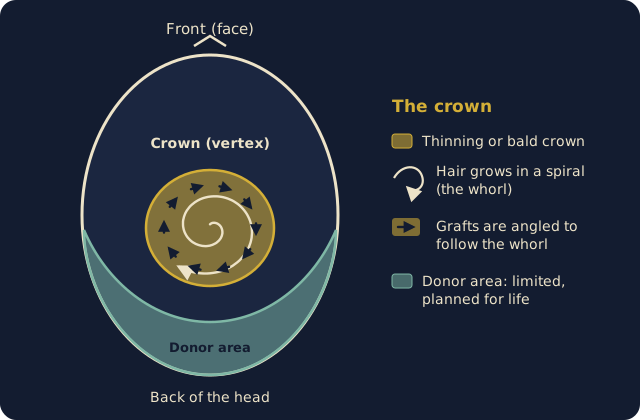
The crown grows in a spiral (whorl) that grafts must follow
Opinion firstsurgery, medical treatment or waiting
2 ABHRS surgeonsDr. Madhu (31 years) and Dr. Ram Sushruth
From ₹60 per graftFUT ₹60, FUE ₹75, + GST
8 to 12 monthsfor the final result
Before you decide
Why a crown hair transplant is not for everyone
A hair transplant is not simply filling a bald area with grafts. Everyone has a limited supply of donor hair, and it has to last a lifetime.
1
The crown needs careful direction planning
The crown has a circular or spiral growth pattern called a whorl. Grafts must follow the natural direction and angles of the surrounding hair; placed wrongly, they look unnatural even when there are enough of them.
2
It can use many donor grafts
In advanced baldness the crown is a large area. Using too many grafts early can leave too little donor hair for later hair loss at the front or mid-scalp, especially in younger patients.
3
Hair loss may still be progressing
Thinning at the crown today can spread to the surrounding areas over the next few years. The surgeon considers your age, family history, current pattern and likely future needs before recommending surgery.
4
More grafts do not always mean more density
Because crown hair grows in a circle, the scalp can show even where hair is present. How full it looks depends on hair thickness, existing hair, how the grafts are spread and the growth direction.
5
Medical treatment may suit early stages
Early crown thinning often still has a lot of existing hair. Depending on the diagnosis, medical treatment to slow hair loss may be more appropriate than surgery now.
This is why an expert opinion matters. A responsible hair transplant surgeon should be equally comfortable recommending surgery, medical treatment or waiting.
Candidates
Who is an ideal candidate for a crown hair transplant?
A crown transplant may suit you if you have established crown baldness or marked thinning and meet the medical and donor-area requirements.
It may suit you if you have
A clearly defined area of crown thinning or baldness
A donor area with good hair density and quality
Hair loss that has been assessed and is stable enough for the plan
Realistic expectations about density and coverage
Understanding that transplanted hair does not stop your other hair from thinning
Medically fit for the procedure
Willing to follow aftercare instructions and attend follow-ups
It may not be recommended yet
Very young, with fast hair loss: the future pattern is not yet clear, so donor hair is hard to plan
Early crown thinning: existing hair may still respond to medical treatment, depending on the diagnosis
Too little donor hair: there may not be enough scalp hair to give useful coverage safely; beard hair may then be an option
Expecting full original density: a transplant improves coverage, but a naturally full scalp cannot always be recreated
Sudden or unexplained hair loss: the cause must be diagnosed first
Unrealistic expectations: the plan has to be built on what can actually be achieved
At Dr. Madhu's, the first aim is to find out whether you are a suitable candidate, not simply to recommend a procedure. See am I a good candidate?
Your consultation
What happens at a crown hair transplant consultation?
An expert consultation answers more than how many grafts you need.
1
Your hair loss history
When it started, how fast it has progressed and whether pattern baldness runs in your family.
2
Examining the crown
The size of the thinning or bald area, the hair still present, your whorl pattern, hair thickness and the hair around it.
3
Assessing the donor area
The back and sides of the scalp are examined for density and quality, to see how many grafts can be taken safely. See the donor area.
If a transplant suits you: the estimated grafts, the technique, the coverage you can expect, its limits, recovery and the cost. You leave with a clear picture of your options, even if surgery is not recommended now.
Techniques
Crown hair transplant techniques
No single technique suits every crown. The choice depends on your donor area, the grafts needed and long-term planning. When scalp donor hair is limited, beard hair is an option.
FUE hair transplant
Grafts are taken one at a time from the donor area and placed in the crown. No linear scar and no stitches, just tiny dot-like marks. ₹75 + GST per graft.
A thin strip is taken from the back of the head and dissected into follicular units under microscopes, then closed with a trichophytic closure. Suits selected patients. ₹60 + GST per graft.
For extensive hair loss, the two techniques can be combined in one session, using the donor area responsibly while getting the best realistic coverage.
When scalp donor hair is limited or already used, beard hair can be transplanted to the crown. Beard hair is thick and has the highest survival of body hair (75% to 95%), and it is usually mixed with scalp grafts so they blend. Body hair can also be used.
How many grafts does a crown hair transplant need?
There is no standard number. Early crown thinning and extensive vertex baldness need very different plans. The number depends on:
The size of the crown area
How much hair is still there
Hair thickness
The coverage you want
How much donor hair is available
Hair loss you may have in future
More grafts do not automatically give a better result. Grafts are spread to follow the whorl, at 25 to 40 grafts per sq cm depending on the grafts and the scalp (dense packing), and within the donor hair you will have for life.
Doctor-led surgery:Dr. P. Ram Sushruth designs the plan, takes the grafts and makes the slits; trained technicians place the grafts under his supervision
Careful graft handling: every graft examined and refined under Mantis and Zeiss microscopes (URFUG)
Is a crown hair transplant recommended for everyone with crown baldness?
No. It depends on your donor hair, age, how your hair loss is progressing, your scalp and your future needs. Some patients do better with medical treatment, or by waiting until the pattern of hair loss is clearer.
Why should I get an expert opinion before a crown hair transplant?
The crown needs careful graft distribution and direction planning. An expert assessment tells you whether surgery suits you, how many grafts may be needed and whether donor hair should be saved for future hair loss.
Which doctors assess crown hair loss at Dr. Madhu's?
Dr. Pathuri Madhu, MD (Dermatology), an ABHRS Diplomate with 31 years in hair restoration, and Dr. P. Ram Sushruth, MD (DVL), an ABHRS Diplomate who is in charge of performing all hair transplant procedures.
Is a crown hair transplant more complicated than a frontal one?
It has different challenges. The circular whorl needs careful planning of graft direction and angles, and a large crown area makes donor planning harder.
Can early crown thinning be treated without a transplant?
Depending on the diagnosis, yes. Early crown thinning may be managed with medical treatment, and a dermatologist decides whether non-surgical treatment suits you.
Does a crown hair transplant need more grafts?
It can, especially when the bald area is large. The number depends on the area, the hair still present, your hair and the donor supply, and the doctors confirm it at a consultation.
Can a crown hair transplant be done by FUE?
Yes. FUE is commonly used for the crown in suitable patients. FUT, or FUE and FUT combined, may also be considered, and when scalp donor hair is limited, beard hair can be transplanted to the crown.
How long does it take to see crown hair transplant results?
The hair looks moderately full around months 4 to 6, and the final result is seen around months 8 to 12. Results vary from person to person.
What if I am not suitable for a crown hair transplant?
The doctor may suggest medical treatment, monitoring or reassessment later. Not having surgery straight away is sometimes the better decision.
Discover if crown hair restoration is right for you. Our surgical team will examine your crown whorl pattern, assess donor capacity, and design a customized long-term treatment plan.
Our clinic is located on Road No. 36, Jubilee Hills, Hyderabad. We welcome patients from Banjara Hills, Madhapur, Gachibowli, across Telangana, Andhra Pradesh, all major Indian cities, and international visitors.
Send photos of your vertex/crown and donor area for a preliminary medical assessment, or speak directly with our ABHRS-certified doctors on WhatsApp or in-person in Jubilee Hills, Hyderabad.